

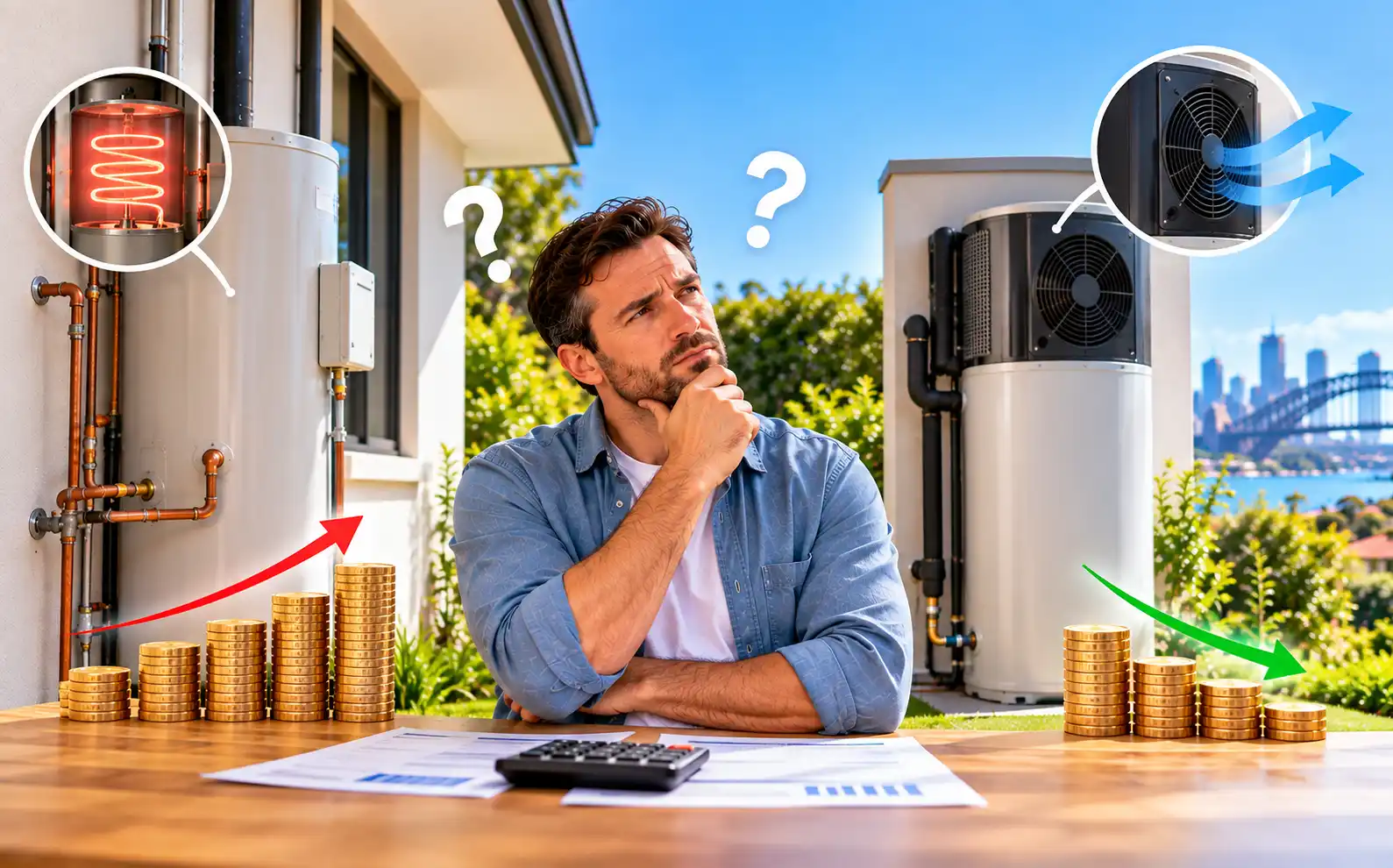
Hot water is usually the second largest line on a Sydney household’s electricity bill, behind heating and cooling. Depending on the house, it accounts for somewhere between 15 and 25 percent of what you pay.
So when a system fails and you are standing in the laundry looking at a leaking tank, the question is a real one: replace like for like with another electric storage unit, or spend more upfront on a heat pump and claw it back on running costs?
The honest answer depends almost entirely on one thing most comparison articles skip. Not the system. Your tariff.
A heat pump uses roughly 60 to 75 percent less electricity than a standard electric storage system to deliver the same hot water. That part is not in dispute.
What changes the maths is that most Sydney electric storage systems are already running on a controlled load tariff, at roughly half the rate your general power costs. A heat pump, in most cases, runs on your general tariff.
So you are not comparing cheap against expensive. You are comparing a lot of cheap electricity against a little expensive electricity, and the gap is narrower than the headline savings figures suggest.
Understanding controlled load, and why it matters here
If your home has an electric storage tank, look at your electricity bill. If you see a separate line labelled Controlled Load 1, Controlled Load 2, or off-peak hot water, your tank is on a dedicated circuit that the network energises only during set windows.
In the Ausgrid and Endeavour Energy areas that typically means:
- Controlled Load 1: roughly 13 to 20 cents per kWh, supplied overnight, commonly around 10pm to 7am
- Controlled Load 2: a slightly higher rate, but supplied for longer, including some daytime hours
- General or flat tariff: roughly 32 to 38 cents per kWh
That is the single most important number in this comparison. Controlled load electricity costs around half what your general supply costs, and it is only available on a separately wired and metered circuit.
A surprising number of Sydney homes have an electric tank sitting on the general tariff by mistake, usually after a switchboard change or a meter upgrade where the circuit was never reinstated correctly. If both usage lines on your bill show the same rate, that is what has happened, and you have been paying roughly double for your hot water ever since.
Running cost comparison for a typical Sydney household
A four-person Sydney home uses somewhere around 3,500 kWh per year on hot water. Here is what that costs under each scenario:
| Setup | Annual energy used | Typical annual cost |
| Electric storage on general tariff | ~3,500 kWh | $1,100 to $1,300 |
| Electric storage on Controlled Load 1 | ~3,500 kWh | $450 to $700 |
| Heat pump on general tariff | ~1,000 kWh | $320 to $380 |
| Heat pump on controlled load or timer | ~1,000 kWh | $130 to $200 |
| Heat pump running on daytime solar | ~1,000 kWh | $50 to $120 |
Figures are energy only and exclude daily supply charges. Your actual usage shifts with household size, tank size, water temperature and how long people spend in the shower.
The pattern is clear enough. A heat pump wins in every scenario. But the size of the win changes dramatically:
- Against electric on general tariff: you save roughly $800 to $950 a year
- Against electric on Controlled Load 1: you save roughly $150 to $350 a year
That is the comparison most articles never make, and it is the one that decides whether a heat pump makes financial sense for your particular house.
What each system costs to install
| System | Typical installed cost in Sydney |
| Electric storage, like-for-like replacement | $1,500 to $3,000 |
| Heat pump, before rebates | $3,500 to $5,500 |
| Heat pump, after NSW and federal incentives | $2,500 to $4,200 |
Two incentives currently stack for eligible NSW households. The NSW Hot Water Upgrade Incentive, delivered under the Energy Savings Scheme, is applied as an upfront discount on the installer’s quote and is worth more when you are replacing an electric resistance tank than a gas unit. Federal Small-scale Technology Certificates are also deducted at point of sale, with the value depending on system size and climate zone.
Rebate values are reviewed regularly and certificate prices move, so treat any figure you read online as indicative and ask your installer for the current deduction on your actual quote. Both schemes have eligibility conditions attached, including minimum warranty terms and a minimum customer contribution.
Working out your payback period
Take the extra upfront cost of the heat pump over a like-for-like electric replacement, then divide by your annual saving.
Scenario one: electric tank currently on the general tariff. Heat pump costs roughly $1,500 more than a new electric tank after rebates. Annual saving around $850. Payback lands somewhere under two years. The heat pump is the obvious choice.
Scenario two: electric tank currently on Controlled Load 1. Same $1,500 price difference. Annual saving around $250. Payback stretches to five or six years, which is still well inside the service life of the unit but a much less dramatic case.
Scenario three: you have rooftop solar. A heat pump timed to run in the middle of the day uses electricity you are otherwise exporting for a few cents. Payback typically falls back under three years regardless of what tariff your old tank was on, and this is where heat pumps genuinely shine.
Scenario three is worth pausing on. If you have solar, the calculation stops being close. Shifting hot water heating into your solar window is one of the most efficient ways to use your own generation, because a heat pump multiplies every kilowatt-hour it draws by a factor of three or four.
The electrical work nobody mentions in the brochure
This is where the quote you were given can come apart, and it is the part a plumber-only comparison tends to skip.
A heat pump usually needs its own circuit. It is a different load profile to a resistive element, and it generally needs a dedicated circuit with correct RCD protection. If your board is full, that becomes a switchboard upgrade before anything else can happen.
Older boards may not have the capacity. Ceramic fuse boards and early circuit breaker panels across Sydney’s older housing stock frequently have no spare ways and no safety switch protection at all. That is a $1,200 to $3,000 job on its own, and it needs to be in your budget from day one rather than discovered on installation day.
Changing tariff is metering work. If you are moving off a controlled load circuit, or want a heat pump wired to one, that touches your meter. Metering changes are Level 2 ASP work, coordinated with Ausgrid or Endeavour Energy, and cannot be carried out by a general electrician. Metering services need to be scheduled alongside the install rather than chased afterwards.
Not every retailer allows a heat pump on controlled load. Some do, some do not, and the supply windows may not suit a heat pump’s slower heating cycle. Confirm with your retailer before you assume the cheapest tariff is available to you.
Placement affects cost and liveability. Heat pumps have an outdoor compressor that produces a low hum. Positioning it away from bedroom windows and neighbouring boundaries matters, and a longer cable run from the board adds to the install price.
So which should you choose?
Choose a heat pump if: your current tank is on the general tariff, you have solar, your household uses a lot of hot water, or your existing unit is more than ten years old and you are replacing it anyway. The case is strong and in some cases overwhelming.
Electric storage may still make sense if: you are on Controlled Load 1, your hot water use is modest, you are in a rental or short-term holding, or your switchboard would need significant work to accommodate a heat pump. A new electric tank at $1,500 to $3,000 with no electrical upgrade required can be the rational call.
Before you decide, do one thing: check your bill for a controlled load line. If there is not one, and you have an electric storage tank, you may be able to reduce your hot water cost substantially without replacing anything at all. That is a conversation worth having before you spend thousands.
Get the electrical side assessed before you buy
Brian Brothers Electrical handles the electrical work around hot water system changeovers across Sydney, from dedicated circuits and switchboard capacity through to Level 2 metering and tariff changes coordinated with your network operator. We can tell you what your board can actually support before you commit to a system, which is cheaper than finding out on installation day.
We work across the Sydney metro area including Parramatta, Penrith, Hornsby, Ryde and the North Shore. See our full range of services or the suburbs we cover.
No hot water right now? Our emergency electrical services run 24 hours a day with on-site attendance within the hour.
Call (02) 9101 4876 or request a free quote.
FAQ :
Is a heat pump cheaper to run than electric hot water in Sydney?
Yes, in every scenario. A heat pump uses around 60 to 75 percent less electricity for the same hot water. The size of the saving depends on your tariff: roughly $800 to $950 a year against an electric tank on the general tariff, but closer to $150 to $350 a year against one already running on Controlled Load 1.
How much does it cost to run an electric hot water system in Sydney?
A four-person household typically uses around 3,500 kWh a year on hot water. On a controlled load tariff at 13 to 20 cents per kWh that costs roughly $450 to $700 a year. On the general tariff at 32 to 38 cents, the same usage costs $1,100 to $1,300.
How much does a heat pump hot water system cost to run?
Around $320 to $380 a year on the general tariff, dropping to $130 to $200 if it runs on a controlled load or timer, and as little as $50 to $120 a year if you have solar and heat during daylight hours.
What is a controlled load tariff and do I have one?
A controlled load is a separately metered circuit that the network energises only during off-peak windows, usually overnight. Check your electricity bill for a line marked Controlled Load 1, Controlled Load 2 or off-peak hot water. If your bill shows only one usage rate and you have an electric tank, it is probably on the general tariff and costing roughly double what it should.
What is the payback period on a heat pump hot water system?
Typically under two years if you are currently on the general tariff, five to six years if you are on Controlled Load 1, and under three years if you have rooftop solar and can time the heating into daylight hours.
Does a heat pump need electrical work before installation?
Usually yes. Most heat pumps need a dedicated circuit with correct RCD protection. If your switchboard has no spare capacity, aswitchboard upgrade is required first, commonly $1,200 to $3,000. Any change to your meter or tariff is Level 2 ASP work that must be coordinated with Ausgrid or Endeavour Energy.
Can a heat pump run on a controlled load tariff?
Sometimes. It depends on your retailer and on whether the supply window suits the heat pump’s heating cycle, which is slower than a resistive element. Confirm availability with your retailer before budgeting on the controlled load rate.
What rebates are available for heat pump hot water in NSW?
Two incentives can stack: the NSW Hot Water Upgrade Incentive under the Energy Savings Scheme, applied as an upfront discount on your quote, and federal Small-scale Technology Certificates deducted at point of sale. Values change with certificate prices and scheme reviews, so ask your installer for the current deduction on your actual quote.
Is it worth replacing an electric hot water system that still works?
If it is on the general tariff, often yes. If it is on controlled load and under ten years old, the payback is slower and it is usually worth waiting until it fails, then upgrading at replacement time when you are spending money anyway.