

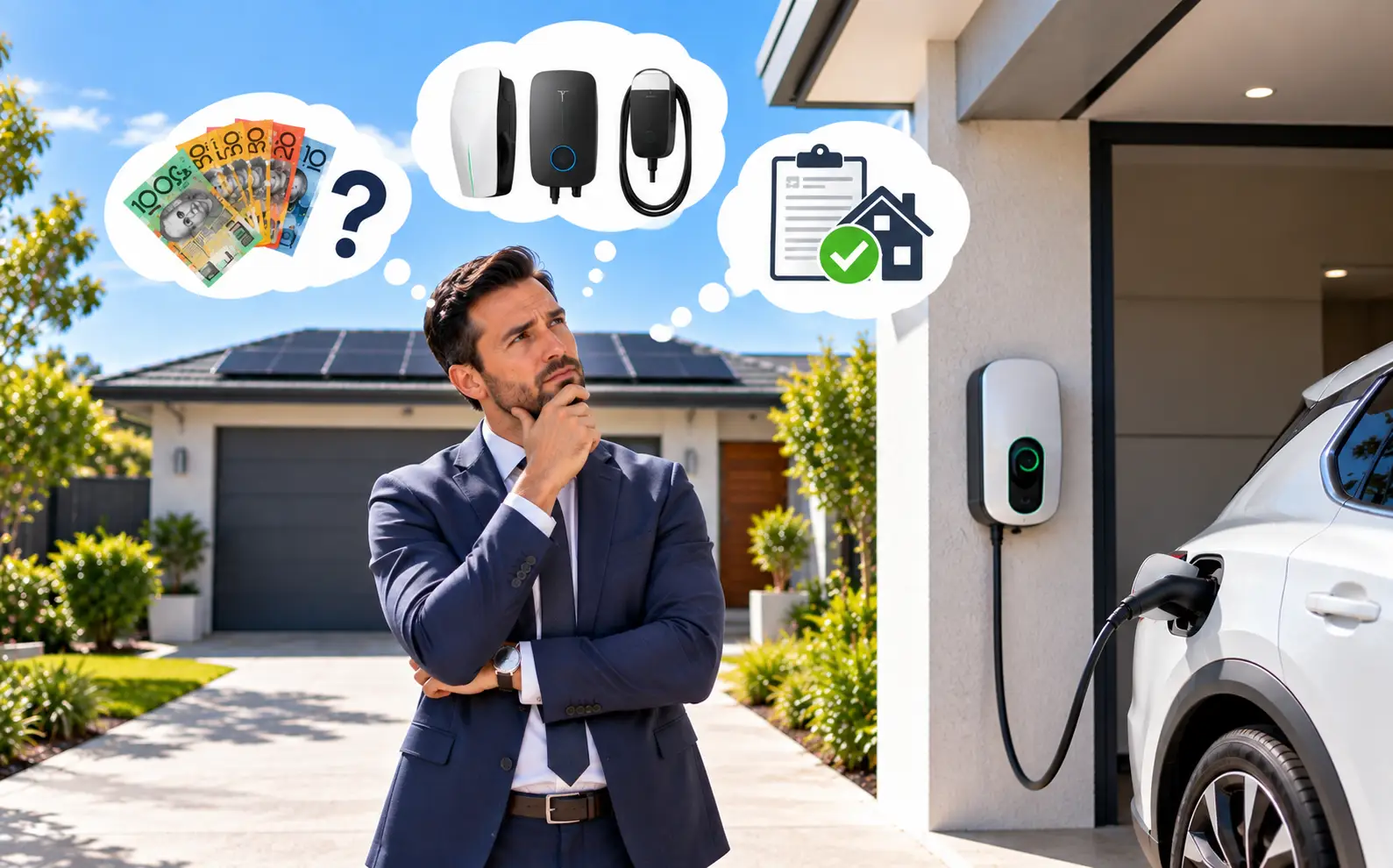
Most people researching EV charger installation in Sydney get the same answer from every site they open: somewhere between $1,200 and $2,500. That number is accurate often enough to be useful and wrong often enough to be a problem.
The charger is a small part of the job. What actually determines your quote is the distance from your switchboard, whether that board can take another circuit, whether you are on single or three-phase supply, and in apartments, whether you can get approval at all.
This guide covers all three: what each option costs, which charger suits which household, and the approvals that catch people out.
Your three charging options
Trickle charging from a standard outlet
Plugging into an existing 10A power point is technically possible and genuinely slow, adding roughly 10 to 15 kilometres of range per hour. For a plug-in hybrid or a second car that does short trips, it can be enough.
It is also the option most likely to cause problems. A standard household outlet was never designed for a continuous high load over eight hours, and running an EV off an old circuit with a shared load is a real risk. If you are going to do this, have the circuit checked and ideally install a dedicated 15A outlet.
Cost: $350 to $650 for a dedicated 15A outlet on a new circuit.
Level 2 wall charger, single-phase
The standard choice for most Sydney homes. A 7kW wall-mounted unit on a dedicated single-phase circuit adds roughly 40 kilometres of range per hour, which means a full charge overnight for almost any EV on the market.
This is the right fit for the large majority of households. Unless you are driving several hundred kilometres a day, faster charging at home solves a problem you do not have.
Cost: $1,200 to $2,500 supply and installed, with simple runs under 10 metres landing at the lower end.
Level 2 wall charger, three-phase
An 11kW or 22kW unit on three-phase power charges considerably faster. It makes sense for households with two EVs, for high-kilometre drivers, and for commercial sites with fleet vehicles.
If your property is already on three-phase, this is a reasonable upgrade for modest extra cost. If it is not, converting from single to three-phase supply is a significant job involving the network operator and the meter, and the charger becomes the smaller line on the invoice.
Cost: $1,800 to $3,000 for an 11kW install on existing three-phase, $2,500 to $4,000 for 22kW. Converting a property to three-phase adds $3,500 to $7,500.
What EV charger installation actually costs in Sydney
| Scenario | Typical installed cost |
| Dedicated 15A outlet (trickle charging) | $350 to $650 |
| 7kW single-phase, cable run under 10m | $1,200 to $1,800 |
| 7kW single-phase, typical install | $1,200 to $2,500 |
| 11kW three-phase on existing supply | $1,800 to $3,000 |
| 22kW three-phase on existing supply | $2,500 to $4,000 |
| Additional cost, cable run over 20m | $300 to $1,200 |
| Switchboard upgrade if required | $1,200 to $3,000 |
| Combined switchboard upgrade plus charger | $2,800 to $5,000 |
| Single-phase to three-phase conversion | $3,500 to $7,500 |
| Strata or apartment installation | $2,500 to $6,000 |
The most common Sydney scenario, a 7kW charger in a garage with a reasonably modern board and a run under 15 metres, sits around $1,400 to $2,200 all up.
Doing the switchboard work and the charger as one job is meaningfully cheaper than two separate visits, because the disconnection, testing and compliance work happens once rather than twice.
The four things that move your quote
Distance from the switchboard. Every metre of cable costs money, and the cost is not linear. A run that needs to go through a wall cavity, under a slab, along a fence line or through conduit across a driveway costs far more than the same distance in an accessible ceiling space.
Switchboard capacity and condition. An EV charger needs its own circuit with correct RCD protection. If your board has no spare ways, that is a replacement rather than an addition. Boards with ceramic fuses, asbestos backing or no safety switch protection need upgrading regardless of the charger.
Your supply capacity. Some older Sydney properties have consumer mains that cannot comfortably carry an EV charger on top of existing load, particularly homes already running ducted air conditioning, a pool pump and an electric hot water system. Where that is the case the options are a mains upgrade, which is Level 2 ASP work, or a load management solution that throttles the charger when household demand peaks.
Charger brand and features. Smart chargers with app control, scheduling and solar integration cost more than basic units. If you have rooftop solar, the scheduling capability is usually worth it, because charging from your own generation rather than the grid is where the running cost savings actually come from.
Approvals: the part most guides skip
Network approval
Your installer needs to notify or apply to Ausgrid or Endeavour Energy depending on the charger capacity and your existing supply. A standard 7kW single-phase install on an adequate supply is usually straightforward. Larger three-phase installations, anything requiring a supply upgrade, and anything involving a change to your consumer mains or meter requires network coordination and is Level 2 ASP work.
Where load is a constraint, the network may accept the installation on condition that the charger uses dynamic load management, limiting its draw during peak periods. This is normal and does not meaningfully affect overnight charging.
Metering
If your charger is going on a dedicated tariff, or you are installing solar at the same time, or your property still has an old accumulation meter, you will need a smart meter before any of it works properly. Metering changes are Level 2 ASP work and should be scheduled alongside the charger install rather than chased separately.
Strata and apartment approvals
This is the genuinely difficult one, and it is where Sydney apartment owners lose months.
Most strata car spaces involve common property, either because the space itself is common property with exclusive use, or because the cable run from the building switchboard crosses it. That brings the installation under the owners corporation’s authority.
NSW now has the most supportive strata framework in the country for EV charging. Charger installations are treated as sustainability infrastructure under the Strata Schemes Management Act, voting thresholds have been reduced, and an owners corporation cannot unreasonably refuse a compliant request. Where a committee does refuse unreasonably, an owner can take the matter to NCAT.
The law in this area is still moving, with further amendments progressing through NSW Parliament, so confirm the current position with your strata manager before you lodge anything.
What makes an application succeed in practice:
- A written quote from a licensed electrician specifying the exact cable route and the extent of any work on common property
- A load assessment showing the building’s supply can carry the charger, with load management specified if needed
- Clarity on who pays for installation, electricity consumed, ongoing maintenance, and any damage to common property, which is normally the lot owner
- A proposed by-law covering what happens when the lot is sold
Buildings that handle this well usually install shared infrastructure, a backbone that individual owners then connect to, rather than approving one-off installations piecemeal. If your building has multiple EV owners, that conversation is worth starting early.
Rental properties
Tenants need the landlord’s approval, and the landlord then deals with the owners corporation if it is a strata property. Portable charging from a dedicated outlet is often the practical compromise.
Should you install solar at the same time?
If you have rooftop solar or are planning it, the economics of home charging change substantially. Charging during daylight hours from your own generation costs a few cents per kilowatt-hour in opportunity cost against your feed-in tariff, compared to 32 to 38 cents on the general tariff.
A smart charger that can schedule around solar output, or simply around an off-peak window, is where the running cost savings actually live. The charger hardware premium for that capability typically pays for itself inside two years for anyone driving normal distances.
If you are planning solar, a battery and an EV charger, have them specified together. Doing them in sequence usually means paying for switchboard work and metering changes more than once.
Get the electrical side assessed first
Brian Brothers Electrical handles EV charger installation across Sydney, from dedicated circuits and switchboard capacity through to three-phase supply upgrades, metering and the Level 2 network coordination that larger installs require. We hold ASP accreditation 4712 and work across both the Ausgrid and Endeavour Energy networks.
We assess the board and the supply before quoting, so the number you get accounts for the actual site rather than a best case that changes on installation day. For strata installations we provide the documentation your owners corporation will ask for.
We cover the Sydney metro area including Parramatta, Penrith, Hornsby, Ryde and the North Shore. Commercial and fleet charging is handled through our commercial electrical services. See our full range of services or the suburbs we cover.
Charger tripping the board, or a fault that cannot wait? Our emergency electrical services run 24 hours a day with on-site attendance within the hour.
Call (02) 9101 4876 or request a free quote.
FAQ :
How much does EV charger installation cost in Sydney?
A 7kW single-phase home charger typically costs $1,200 to $2,500 supply and installed. Simple runs under 10 metres sit at the lower end. Three-phase installs run $1,800 to $4,000 on existing supply, and a switchboard upgrade adds $1,200 to $3,000 where one is needed.
Do I need a special electrician to install an EV charger?
A licensed electrician can install a standard single-phase charger on an adequate existing supply. Anything involving your meter, your consumer mains, or a supply upgrade is Level 2 ASP work and must be carried out by an Accredited Service Provider coordinated with Ausgrid or Endeavour Energy.
Can I just plug my EV into a normal power point?
You can, but it is slow at roughly 10 to 15 kilometres of range per hour, and a standard outlet is not designed for a continuous high load over many hours. If you plan to charge this way regularly, have a dedicated 15A outlet installed on its own circuit.
Do I need a switchboard upgrade for an EV charger?
Only if your board lacks spare capacity or adequate RCD protection. Many Sydney homes built before the 1990s do. A charger needs its own dedicated circuit, so a full board with no spare ways means a switchboard replacement before the charger can go in.
Can I install an EV charger in a Sydney apartment?
Usually yes, but it requires owners corporation approval because the car space or cable run almost always involves common property. NSW treats EV charging as sustainability infrastructure with reduced voting thresholds, and an owners corporation cannot unreasonably refuse a compliant request. Strata installations typically cost $2,500 to $6,000.
Can my strata refuse an EV charger in NSW?
Not unreasonably. NSW law provides stronger protection for EV charging than any other state, and an owner can apply to NCAT where a refusal is unreasonable. The legislation in this area is still being amended, so confirm the current position with your strata manager.
Do I need three-phase power for an EV charger?
No, for most households. A 7kW single-phase charger fully charges almost any EV overnight. Three-phase makes sense for two-EV households, high-kilometre drivers and commercial fleets. Converting a single-phase property adds $3,500 to $7,500.
Should I get a smart charger?
If you have solar, or if you want to schedule charging into off-peak hours, yes. The ability to charge from your own generation or at the cheapest tariff is where the running cost savings come from, and the hardware premium usually pays back within a couple of years.
Do I need a smart meter for an EV charger?
Effectively yes if you want time-of-use or dedicated EV tariffs, and definitely if you are installing solar at the same time.Metering changes are Level 2 ASP work and are best scheduled alongside the charger install.