

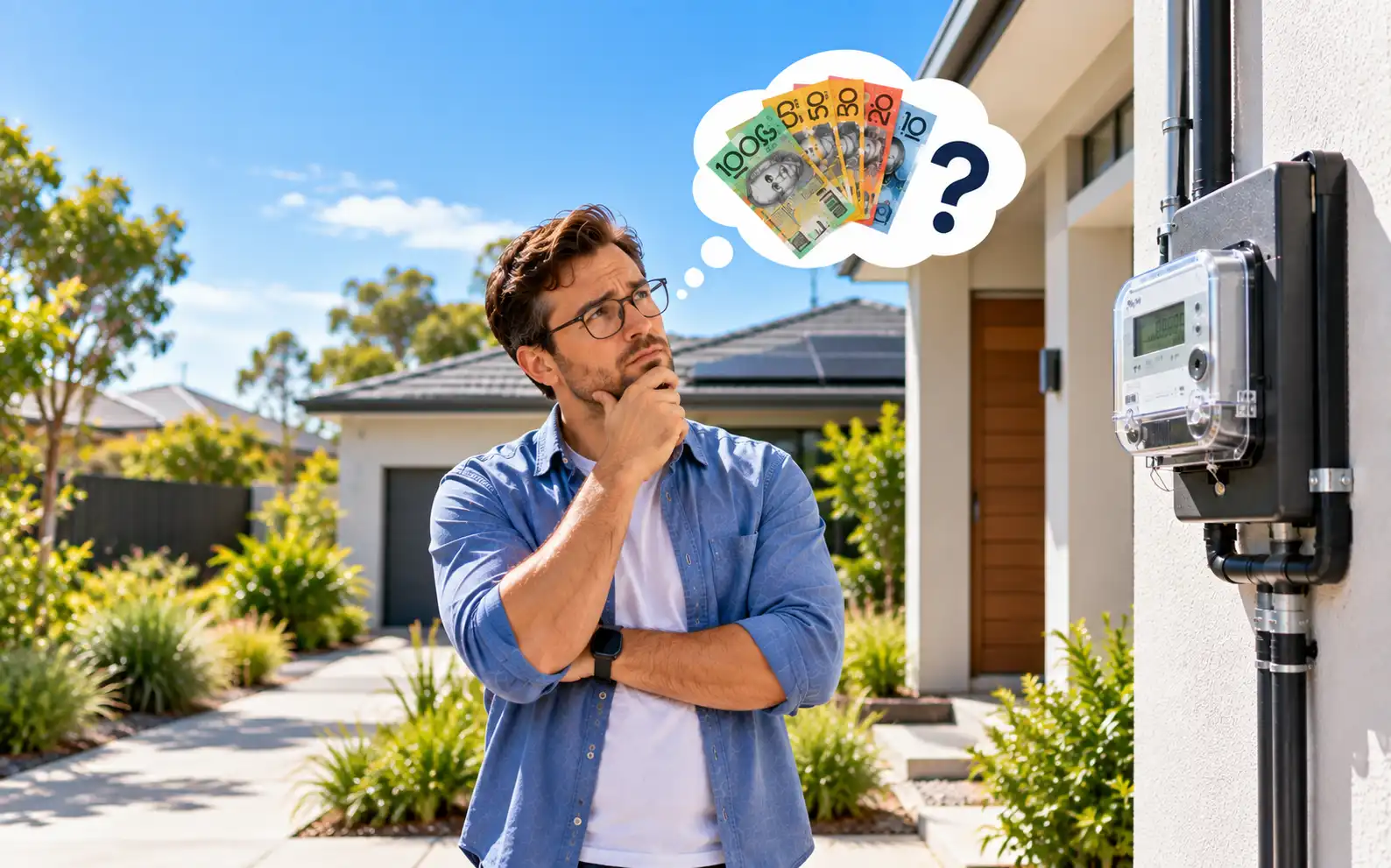
Smart meter installation in Sydney is no longer a question of whether, only when and how much. Under rules finalised by the Australian Energy Market Commission, every property connected to the National Electricity Market must have a smart meter by 30 November 2030, and the opt-out that used to exist has been removed.
For most Sydney households that means a free meter swap arranged by your retailer at some point before the deadline. For a smaller group it means a bill, sometimes a substantial one, because the meter is the easy part and the board around it is not.
This guide covers both routes to getting a smart meter in Sydney, what each actually costs, and the site conditions that turn a straightforward swap into a larger job.
What a smart meter actually does
A smart meter is a digital electricity meter that records your usage in short intervals and sends the readings to your retailer automatically. No more estimated bills, no more quarterly visits from a meter reader, and no more waiting months to discover a usage spike.
It is also the gateway to almost everything else happening in household energy. Time-of-use tariffs, solar feed-in, home batteries and EV charging all depend on interval data that an old accumulation meter simply cannot produce.
Route one: wait for the free rollout
The simplest way to get a smart meter installed in Sydney costs nothing upfront.
Your retailer contacts you when your property comes up in the rollout schedule, arranges a metering provider, and the meter is swapped. The attendance usually takes around an hour and involves a short power interruption.
What you are entitled to:
- Advance notice from your retailer, including a five business day date range for the installation
- No upfront fee where the retailer initiates the installation
- Two years of tariff protection, meaning your retailer cannot move you to a different tariff structure without your explicit consent
What you are not entitled to: choosing the timing or the provider. You get the meter when the rollout reaches your street, not when it suits your renovation schedule or your solar install date.
There is also a cost that is easy to miss. The meter is not truly free, it is recovered over time through your daily supply charge rather than billed as a lump sum.
You can also ask to go early. If you contact your retailer and request a smart meter ahead of your scheduled turn, they have 20 business days to arrange it. The catch is that a customer-requested installation can attract a fee, which is also the case where the trigger is a solar or battery install.
Route two: arrange it yourself through a Level 2 electrician
The second path is to organise the work directly, which is what most people do when the smart meter is tied to another project rather than being an upgrade for its own sake.
This is the right route if you are:
- Installing solar or a home battery
- Fitting an EV charger
- Building, renovating, or adding a granny flat
- Subdividing or splitting a supply
- Moving from single-phase to three-phase power
- Dealing with a damaged, faulty or end-of-life meter that cannot wait for the rollout
- Relocating the meter for access or as part of a build
Critically, you cannot do this work yourself and neither can a general electrician. In NSW, anything on the supply side of the meter, between your property and the network, is Level 2 Accredited Service Provider work. Smart meter installation sits squarely in that category.
Brian Brothers Electrical is an ASP Level 2 accredited team working across both the Ausgrid and Endeavour Energy networks, which is exactly the accreditation a smart meter installation in Sydney requires. Our metering services cover new meter installations, meter upgrades, relocations and removals for residential and commercial properties.
What smart meter installation costs in Sydney
| Scenario | Typical cost |
| Rollout swap initiated by your retailer | $0 upfront |
| Customer-requested meter upgrade | $300 to $600 |
| Meter board replacement | $800 to $1,800 |
| Switchboard upgrade, standard single-phase | $1,200 to $3,000 |
| Switchboard with asbestos backing panel | $2,200 to $4,200 |
| Consumer mains upgrade | $1,500 to $3,000 |
| Single-phase to three-phase meter and supply | $3,500 to $7,500 |
The meter itself is rarely where the money goes. The variable is the condition of everything around it, and in Sydney’s older housing stock that variable can be significant.
Why smart meter installations get knocked back
This is the part homeowners do not see coming. A metering provider arrives, looks at the board, and declines to proceed because the site is not compliant. The meter leaves with them and you are left arranging remedial work before anyone will come back.
The common blockers across Sydney properties:
Asbestos backing panel. Extremely common in homes built before the mid-1980s. The panel must be removed by a licensed process and the board rebuilt before a new meter can be fitted. This is the single largest cost driver on this list.
No main switch or isolation point. Older boards often have no way to safely isolate the installation. No installer will work live on a non-compliant board.
No spare capacity. If the board is full, a smart meter plus any new circuit means a full switchboard replacement rather than a swap.
No RCD protection. Boards without safety switches do not meet current requirements and typically need upgrading at the same time.
Deteriorated consumer mains. UV-damaged or undersized mains between the point of attachment and your board are a frequent finding, particularly on properties with overhead supply.
Rusted or water-damaged meter enclosure. An external box that has failed needs replacing before new equipment goes in.
An outstanding defect notice. If Ausgrid or Endeavour Energy has already issued a defect notice on your property, that work has to be cleared first and within the deadline on the notice.
Every item on that list is the property owner’s cost, not the retailer’s, regardless of which route you took to the smart meter.
The sequence that saves money
The expensive version of this job is doing it in pieces. A metering provider attends and declines. You call an electrician. The electrician discovers the board needs work. The board work happens. The metering provider is rebooked. Three attendances where one would have done.
The cheaper version is to have a Level 2 ASP electrician assess the board before anything is scheduled, so any remedial work, meter installation and network coordination are planned as one sequence. If your property needs a board upgrade anyway, doing it alongside the meter change avoids paying twice for the same disconnection and reconnection.
That assessment is worth doing early if your home was built before 1990, if your board still has ceramic fuses, if you are planning solar within the next year, or if you have never had any work done on the meter board.
What a smart meter changes on your bill
A smart meter does not automatically change your tariff. Your retailer needs your explicit consent to move you to a different tariff structure for two years after installation, and flat-rate plans remain available.
What it does change is visibility. Interval data means you can see exactly when your electricity is being used, which is what makes time-of-use plans, solar self-consumption and off-peak scheduling worth evaluating in the first place. Whether those plans suit your household is a question you can finally answer with your own data rather than a guess.
If your home has an electric hot water system on a controlled load circuit, raise that with your installer before the swap. Controlled load arrangements need to be carried through correctly to the new meter, and this is one of the more common things to go wrong in a rushed changeover.
Apartments, strata and commercial sites
Shared buildings are handled as groups rather than individually, which is more efficient but means less control over timing. Where a building has an embedded network, such as some apartment complexes and retirement villages, different rules apply and replacement meters are not required to be smart meters.
Commercial properties are a separate conversation again. Three-phase metering, CT metering on larger supplies and multi-tenancy arrangements all need to be specified correctly, and we handle these as part of our commercial electrical services.
Book a Level 2 ASP assessment
Brian Brothers Electrical holds ASP accreditation 4712 and carries out smart meter installation in Sydney across the Ausgrid and Endeavour Energy networks. We assess the board first, quote the actual scope rather than a best case, and coordinate the network side so the job completes in one visit wherever the site allows.
We cover the Sydney metro area including Parramatta, Penrith, Hornsby, Ryde and the North Shore. See our full range of services or the suburbs we cover.
No power, a failed meter or a damaged service line? Our emergency electrical services run 24 hours a day with on-site attendance within the hour.
Call (02) 9101 4876 or request a free quote.
FAQ:
How much does a smart meter cost to install in Sydney?
Nothing upfront where your retailer initiates the swap under the national rollout, though the meter is recovered over time through your daily supply charge. A customer-requested smart meter installation typically costs $300 to $600, and any meter board or switchboard remediation is charged on top.
Who can install a smart meter in NSW?
Only anAccredited Service Provider Level 2 electrician authorised under the Ausgrid or Endeavour Energy network. The work connects to the electricity network, so neither a homeowner nor a general licensed electrician can carry it out.
Can I refuse a smart meter in NSW?
No. The opt-out was removed and all National Electricity Market customers must have a smart meter by 30 November 2030. If your retailer contacts you to arrange installation, you cannot decline it.
Can I get a smart meter before my scheduled rollout turn?
Yes, through two routes. You can ask your retailer, who then has 20 business days to arrange it, or you can engage a Level 2 ASP electrician directly. The second route is the usual one when the meter is tied to solar, a battery, an EV charger or a renovation. Either way a fee may apply because you initiated it.
How long does smart meter installation take?
The meter swap itself usually takes around an hour, with a short power interruption. If the meter board needs remediation first, that becomes a separate and longer piece of work.
Why was my smart meter installation rejected?
Most commonly an asbestos backing panel, no main switch or isolation point, no spare capacity on the board, missing RCD protection, deteriorated consumer mains, a failed meter enclosure, or an outstanding defect notice. All of these are the property owner’s cost to rectify.
Will a smart meter change my electricity tariff?
Not automatically. Your retailer needs your explicit consent to move you to a different tariff structure for two years after installation, and flat-rate plans must remain available. What changes is that you get interval data showing exactly when you use electricity.
Do I need a smart meter for solar or an EV charger?
Effectively yes. Solar feed-in and EV charging tariffs both depend on interval metering that older accumulation meters cannot provide. A smart meter upgrade is usually scheduled as part of the same Level 2 job.
What happens to my controlled load hot water circuit?
It should carry across to the new meter, but raise it with your installer beforehand. Controlled load arrangements being lost or misconfigured during a meter changeover is a common and expensive error, because it can push your hot water onto the general tariff at roughly double the rate.