

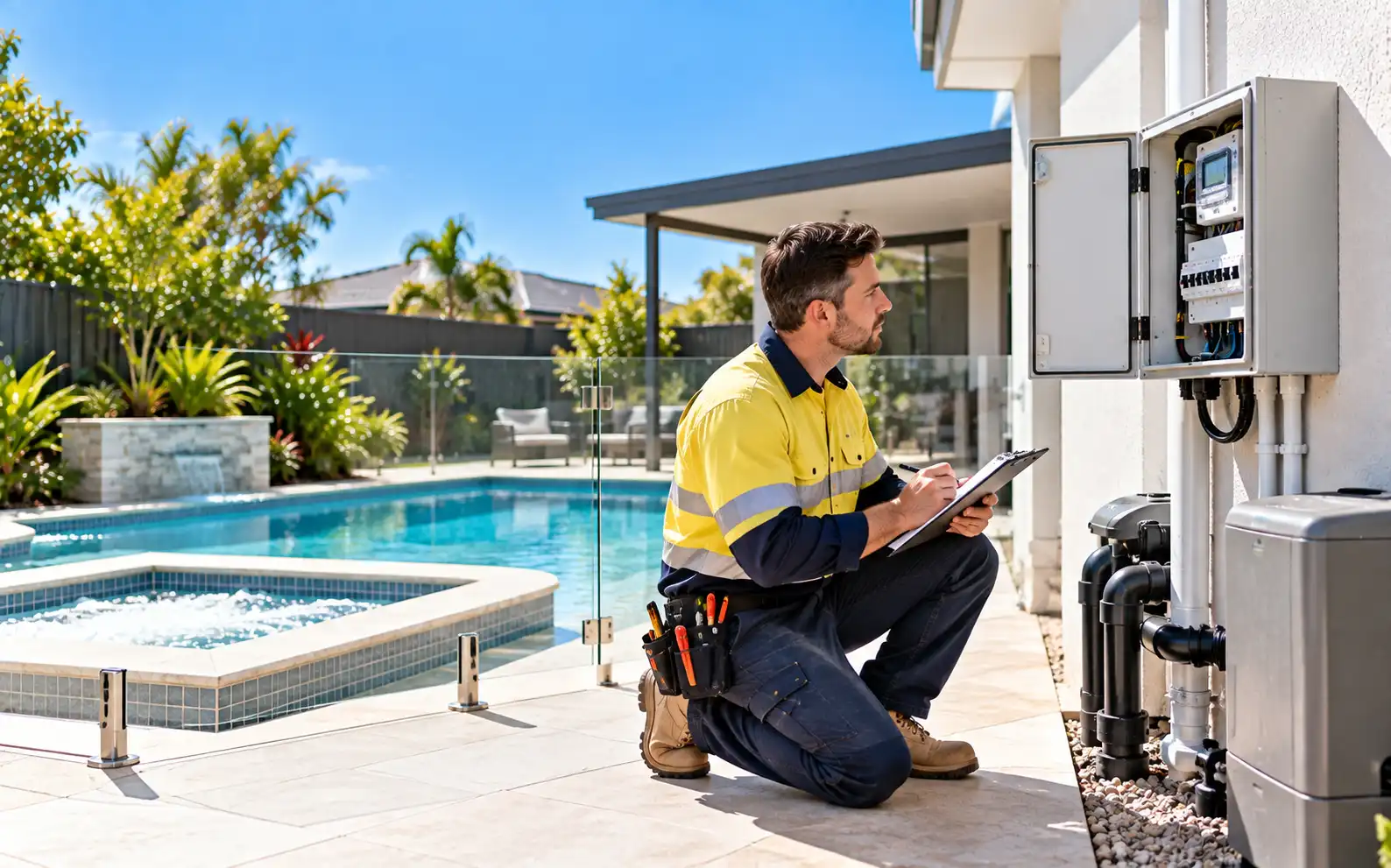
Most NSW pool owners believe their pool has been checked. They have a Certificate of Compliance from council, the gate self-closes, the fence passed inspection, and the paperwork is filed away.
What almost nobody realises is that the certificate covers the barrier and nothing else. The inspector who signed it did not test an RCD, did not check the bonding, and did not look at the pump circuit. Electrical compliance around a pool in NSW runs on an entirely separate track, and it is a track that very few properties are ever checked against.
This guide covers what the rules actually require, what typically goes wrong in Sydney pools, and when you are legally obliged to involve a licensed electrician.
Two compliance systems, often confused
The Swimming Pools Act 1992 governs barriers. Your pool must be registered on the NSW Swimming Pool Register, and a Certificate of Compliance confirms the fence, gate and barrier meet the requirements. You need one to sell or lease the property, and it is generally valid for three years.
AS/NZS 3000, the Wiring Rules, governs the electrical installation. Section 6 deals specifically with swimming pools, paddling pools and spa pools, setting out classified zones, which equipment may be installed where, RCD protection and equipotential bonding. Clause 5.6 covers the bonding requirements.
Nothing in the first system checks the second. A pool can hold a current Certificate of Compliance while sitting on wiring that has not met the standard for thirty years.
Why pool electrics are treated differently
Water lowers the body’s electrical resistance significantly. Add bare wet feet on a conductive surface and the current required to cause a serious injury drops to a fraction of what it would take indoors.
There is also a failure mode unique to water. If an insulation fault energises a metal component near the pool, a voltage difference can appear between the water and the surrounding deck, the ladder, the handrail or the fence. A swimmer bridging those two surfaces becomes the path for that current. They do not need to touch faulty equipment. They only need to touch two things at different potentials.
That is the entire reason equipotential bonding exists.
Equipotential bonding, the rule most pools fail
Bonding means deliberately connecting every conductive item in and around the pool to a common earthing point so no voltage difference can develop between them.
Under the Wiring Rules this must include:
- The conductive components of the pool or spa structure, including the steel reinforcing within a concrete shell
- Exposed conductive parts of any electrical equipment within the pool zone, generally measured as 1.25 metres from the water’s edge
- Exposed conductive parts of any equipment in contact with the pool water
- Any fixed conductive material within that zone, which in practice means metal fencing, ladders, handrails, gates, diving board structures and light fittings
- The earthing conductors of each circuit supplying the pool, or the earth bar at the originating switchboard
Since the 2018 edition of the standard, an accessible bonding connection point is mandatory, so items added later can be properly connected rather than left out.
That last requirement matters enormously in practice, because it addresses the most common real-world failure.
The failure almost nobody anticipates
A homeowner replaces a tired pool fence. The fencing contractor removes the old panels, including the bonding conductor attached to one of them, and installs the new fence. Nobody reconnects the bond.
The pool now looks better, passes a barrier inspection, and has lost its electrical protection entirely. The same thing happens when a ladder is replaced, a handrail is upgraded, a new metal gate goes in, or decking is rebuilt around the coping.
None of this work requires an electrician under the barrier rules. All of it can break the bonding system. If any metalwork around your pool has been replaced since the pool was built and no electrician was involved, that bond should be tested.
RCD protection on every pool circuit
Every circuit supplying equipment within the classified pool zones must have residual current device protection rated at 30 milliamps. That covers the pump, the lighting, the chlorinator, the heater and any power outlets in the area.
This is where older Sydney pools fail most often. Pool circuits run directly off the main switchboard, and if that board predates the mandatory RCD requirements, there is nothing protecting them. Boards with ceramic fuses have no RCD protection at all, and plenty of them are still in service across Sydney.
Having safety switches installed on pool circuits is the single highest-value fix on an older property. Where the board has no spare capacity, a switchboard upgrade is required first.
An RCD that exists is not the same as an RCD that works. They should be tested regularly using the test button, and properly tested with instruments periodically. A failed RCD gives no warning.
Overhead power lines
Where a property has overhead supply, a minimum clearance of 3.5 metres in any direction is required between the pool water and any overhead line.
This catches people in two directions. Building a pool under or near an existing service line is one. The other is extending a pool, adding a spa, or installing a pool-side structure that brings the water or an access surface closer to a line that was previously compliant.
Where clearance cannot be achieved, the service may need to be relocated or converted underground. That is Level 2 ASP work requiring coordination with Ausgrid or Endeavour Energy, and it needs to be identified at the design stage rather than discovered mid-build.
Equipment requirements
Pumps should be on a dedicated circuit, correctly sized, with RCD protection and an enclosure rated for the conditions. Metallic pump motors must be bonded.
Underwater lighting must comply with the Wiring Rules. Modern installations use extra-low voltage lighting with the transformer located well outside the pool zones. Older mains-voltage underwater lighting is a serious hazard and should be assessed by an electrician rather than left in service.
Power outlets within the pool zone must be weatherproof, correctly rated and RCD-protected. Many Sydney pool areas have an outdoor outlet added years after the pool was built, often on a general circuit with no RCD and no bonding consideration.
Heat pumps and pool heating are a growing category of problem. A pool heat pump is a significant additional load that frequently requires a new circuit and sometimes a board upgrade, and it sits squarely within the zones.
Spas, and the portable spa problem
Spa pools are covered by the same rules, with the standard treating spa pools and tubs above a specified capacity as requiring the full set of requirements.
Portable and inflatable spas are where the real risk sits, because they are sold as a plug-in product and bought without any thought to the wiring. The common pattern is a portable spa running from an extension lead into an outdoor power point on an unprotected circuit, with no bonding of any kind.
If you have a portable spa, it needs its own RCD-protected outlet, no extension leads, and an assessment of whether bonding applies to its location and surrounds. This is a short, inexpensive job and it addresses a genuinely dangerous setup.
When you must involve a licensed electrician
- Building a new pool or spa. Involve the electrician at the design stage, not after the shell is poured. Bonding the reinforcing steel is straightforward before concrete goes in and expensive afterwards.
- Renovating or resurfacing a pool, particularly where coping, decking or the shell is disturbed.
- Replacing any fencing, gate, ladder, handrail or metal structure around the pool, because the bond is almost certainly affected.
- Adding or replacing a pump, heater, chlorinator, lighting or robotic cleaner circuit.
- Installing solar pool heating, which adds roof plant and controls on a circuit that needs to be right.
- Buying a property with a pool, where the barrier certificate tells you nothing about the wiring.
- Leasing out a property with a pool, because landlord duty of care extends to the electrical installation regardless of what the barrier certificate says.
What an electrical pool inspection involves
An electrician will test RCD operation on all pool circuits, verify continuity of the bonding system across every conductive item within the zone, check that a compliant bonding connection point exists and is accessible, assess equipment ratings and enclosures, check zone clearances including overhead lines, and review the switchboard for capacity and protection.
This is an hour or two of work on most properties, and it is not expensive relative to what it rules out. Remedial work varies: reconnecting a broken bond is minor, retrofitting RCDs is moderate, and a board replacement where one is needed runs $1,200 to $3,000.
Get your pool’s wiring checked properly
Brian Brothers Electrical carries out pool and spa electrical inspections, bonding verification, RCD retrofits, switchboard upgrades and pool equipment circuits across Sydney. We work on new pool builds alongside the pool builder from the design stage, and on existing pools where nobody has looked at the wiring since installation.
We cover the Sydney metro area including Parramatta, Penrith, Hornsby, Ryde and the North Shore. See our full range of services or the suburbs we cover. Commercial and strata pools are handled through our commercial electrical services.
If anyone has received a shock or a tingle near the pool, stop using it immediately, isolate the pool circuits at the board, and call us. Our emergency electrical services run 24 hours a day with on-site attendance within the hour.
Call (02) 9101 4876 or request a free quote.
FAQ:
What is equipotential bonding for a pool?
Connecting every conductive item in and around the pool to a common earthing point so no dangerous voltage difference can develop between them. It covers the pool shell reinforcing, metal fencing, ladders, handrails, gates, light fittings and any fixed metal within roughly 1.25 metres of the water.
Do pool circuits need a safety switch in NSW?
Yes. Every circuit supplying equipment in the classified pool zones requires RCD protection rated at 30 milliamps. This includes the pump, lighting, chlorinator, heater and any outlets in the area.
Can replacing a pool fence affect electrical safety?
Yes, and this is one of the most common faults found. The bonding conductor is frequently attached to the old fence and is not reconnected when a new one goes in. The pool then looks compliant and has lost its electrical protection. Have the bond tested after any metalwork around the pool is replaced.
How far must a pool be from overhead power lines?
A minimum clearance of 3.5 metres in any direction between the pool water and any overhead line. Where that cannot be achieved, the service may need relocating or undergrounding, which is Level 2 ASP work coordinated with the network operator.
Are portable and inflatable spas covered by the rules?
Yes, and they are a common risk because they are sold as plug-in products. A portable spa should run from its own RCD-protected outlet with no extension leads, and the location should be assessed for bonding requirements.
My pool was built in the 1980s. What is likely wrong?
Typically no RCD protection on the pool circuits, mains voltage underwater lighting, bonding that was never installed or has since been broken, outdoor outlets added later on unprotected circuits, and a switchboard that predates current requirements.
Do I need an electrician when building a new pool?
Yes, and involve them at the design stage rather than after construction. Bonding the reinforcing steel is simple before the concrete is poured and considerably more difficult afterwards. The electrician also needs to assess supply capacity, overhead clearances and where equipment can safely be located.
I am selling a property with a pool. What should I check?
The barrier certificate is a legal requirement and tells a buyer nothing about the wiring. An electrical inspection of the pool circuits is worth doing before listing, because bonding and RCD faults are both cheaper to fix on your timetable than during a negotiation.