

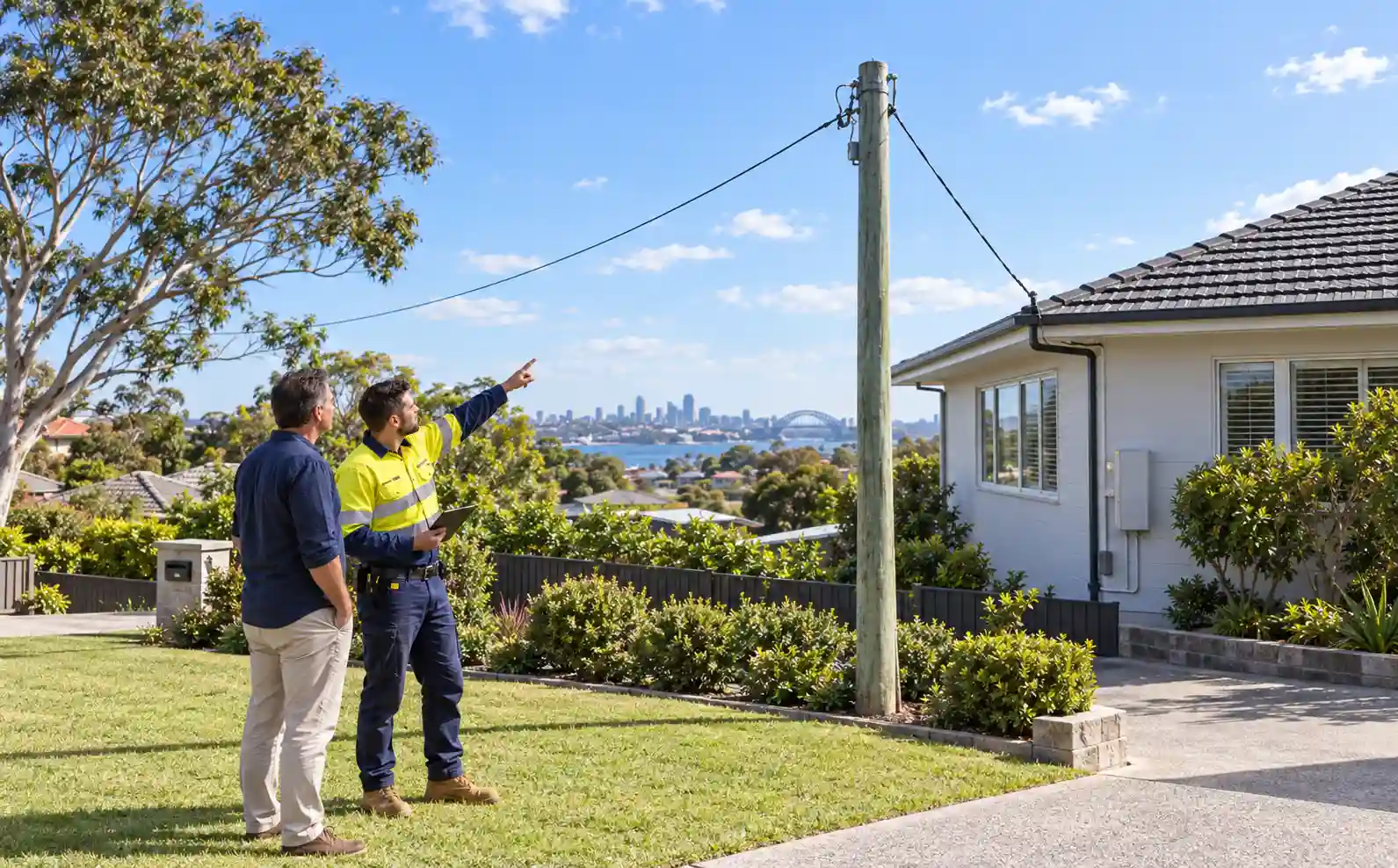
Here’s a surprise that catches out thousands of Sydney homeowners: the power pole standing in your front yard or down the side of your block might not belong to the electricity company at all. It might be yours. And if it’s yours, then repairing it, replacing it and keeping it safe is your job and your bill, not Ausgrid’s.
Most people only find this out the hard way, when a defect notice arrives in the mail or a pole comes down in a storm and the distributor says they won’t touch it. This guide walks you through what you actually own, how to tell, what it costs, and what to do if a notice lands.
The line that decides everything: the point of attachment
There’s a single point that separates the network’s property from yours. It’s called the point of attachment (POA), the bracket or connection where the service wire from the street meets your property’s supply.
Everything on the street side of that point belongs to the network provider. Everything past it, running to your switchboard or meter, belongs to you. This isn’t a grey area or a matter of opinion. It’s set out in the NSW Electricity Supply Act 1995, and it covers ownership, cost and maintenance in one clean line.
So the question isn’t really “who owns the pole?” It’s “which side of the point of attachment is the pole on?”
What makes a pole a private pole
If a power pole sits inside your property boundary and carries supply from the network’s connection point to your building, it’s a private pole, and you own it. From the day it’s installed, it’s your asset, the same as your roof or your fence.
The network providers (Ausgrid, Endeavour Energy and Essential Energy) own and maintain the poles in the street, in public areas and in easements. Once a pole crosses your boundary line, responsibility shifts to the property owner.
Private poles are most common on:
- Larger blocks and rural-style properties where the supply runs a fair distance from the street
- Long driveways where the connection point sits well inside the boundary
- Older homes across areas like the North Shore and Northern Beaches where the original supply was set up this way
- Properties with a second structure, like a granny flat or shed, fed from a pole on the land
You don’t opt into owning one. If your property came with a private pole, it’s been yours since you bought the place, whether you knew it or not.
How to tell if the pole is yours
A quick way to work it out: follow the wire. If the overhead line runs from a street pole to a pole inside your boundary, and from there to your home, the pole on your land is almost certainly private. If the wire runs straight from a street pole to a bracket on your house with no pole on your property, you probably don’t have a private pole.
When you’re not certain, a licensed electrician can identify the point of attachment and tell you exactly where the network’s responsibility ends and yours begins. It’s worth knowing before a problem forces the question.
What a defect notice means
This is where private pole ownership stops being theoretical. Ausgrid and the other networks run scheduled inspections of private poles and powerlines, particularly in bushfire-prone areas, because a failing pole is a fire and safety risk. These patrols are required under NSW Government legislation aimed at reducing bushfires starting from the electricity network.
If an inspection finds a problem, corrosion, decay, a lean, sagging wires or vegetation too close to the lines, the network issues a defect notice to you, the property owner. Under the NSW Electricity Supply Act 1995, you must respond to that notice within 30 days.
A defect notice is not a suggestion. Ignoring it doesn’t make it go away. In practice, an unaddressed notice usually ends one of two ways: your supply gets disconnected until the fault is fixed, or the situation escalates into a larger, more expensive problem. It’s your responsibility to arrange and pay for a qualified contractor to carry out the required work.
Warning signs your private pole needs attention
You don’t have to wait for a defect notice. If you spot any of these, get the pole checked:
- A lean that wasn’t there before, or one that’s getting worse
- Rot at the base of a timber pole, soft or crumbling wood, or fungus
- Rust or corrosion on a steel pole or its fittings
- Sagging wires or lines hanging lower than they used to
- Cracks, splits or charring anywhere on the pole
- Trees or branches growing into the clearance zone around the lines
Catching a failing pole early is far cheaper than dealing with a collapse, and much safer.
What does a private power pole cost to repair or replace?
Cost depends on what the job needs. A minor repair or refit of pole-top fittings sits at the lower end. A full pole replacement, especially where the old one has to come out, a new pole goes in, and the supply is disconnected and reconnected, costs more. The variables are the pole type, access to the site, the height and length of the span, and whether the consumer mains or point of attachment also need work.
One thing worth checking: your home insurance. Some policies cover storm damage to private poles and some don’t, so it’s worth knowing where you stand before you need to.
Who can legally work on a private power pole?
Not a general electrician, and definitely not you. Any work on a private power pole in NSW must be carried out by a Level 2 Accredited Service Provider (ASP), a specific accreditation that authorises work on the network side of your supply.
That’s because the job involves the connection between your property and the grid, work a standard electrical licence doesn’t cover. A Level 2 ASP can:
- Repair or replace the pole itself
- Fix or replace the point of attachment
- Handle the disconnection and reconnection of supply needed to do the work safely
- Issue the Certificate of Compliance for Electrical Work (CCEW) and coordinate reconnection with the network provider
That last point matters. The network won’t restore your supply until the compliance certificate is lodged, so the whole job, from pole to paperwork to reconnection, runs through the Level 2 ASP.
Brian Brothers Electrical is a licensed Level 2 ASP team working across Sydney’s Ausgrid and Endeavour Energy networks, which is exactly the accreditation private pole work requires.
What to do if you’ve got a private pole problem
- Confirm it’s yours. Check whether the pole sits inside your boundary and past the point of attachment. An electrician can confirm this.
- Don’t ignore a defect notice. The 30-day clock is real, and disconnection is the alternative.
- Get a Level 2 ASP to assess it. They’ll tell you whether it’s a repair or a replacement and what’s involved.
- Check your insurance for storm damage cover while you’re at it.
Sort out your power pole the right way
If you own a private power pole in Sydney, keeping it safe is your legal responsibility, and when something goes wrong it needs a Level 2 ASP to fix it properly and get your supply reconnected. Leaving it, especially after a defect notice, risks disconnection and a bigger bill down the track.
Brian Brothers Electrical handles private pole repairs and replacements, defect notice work, consumer mains and point-of-attachment jobs across Sydney. Get in touch for an assessment and we’ll tell you exactly what your pole needs and what it involves.
FAQs
Who owns the power pole on my property in NSW?
If the pole sits inside your property boundary and past the point of attachment, you own it. The network provider (Ausgrid, Endeavour or Essential) owns the poles in the street and public areas, but a private pole on your land is your asset and your responsibility.
Does Ausgrid repair private power poles?
No. Ausgrid maintains its own network in the street, but private poles and the wiring on your side of the point of attachment are the owner’s to maintain and repair. Ausgrid inspects private poles for safety and can issue a defect notice, but the repair is arranged and paid for by you.
What happens if I ignore a power pole defect notice?
Ignoring it doesn’t make it disappear. Under the NSW Electricity Supply Act 1995 you must respond within 30 days, and an unaddressed notice typically leads to your supply being disconnected until the fault is fixed.
How do I know if the pole on my land is private?
Follow the wire. If the overhead line runs from a street pole to a pole inside your boundary and then to your home, that pole is almost certainly private. A licensed electrician can confirm it by identifying the point of attachment.
Who can legally replace a private power pole in NSW?
Only a Level 2 Accredited Service Provider (ASP). The work connects to the electricity network, which a standard electrician’s licence doesn’t cover. The Level 2 ASP also issues the compliance certificate and coordinates reconnection with the network.
Does home insurance cover private power pole damage?
Sometimes. Some policies cover storm damage to private poles and some don’t, so it’s worth checking your specific policy before you need to make a claim.
How much does it cost to replace a private power pole?
It varies with the pole type, site access, span length and whether the consumer mains or point of attachment also need work. A minor repair is at the lower end, while a full replacement with disconnection and reconnection costs more. A Level 2 ASP can quote after assessing the site.