

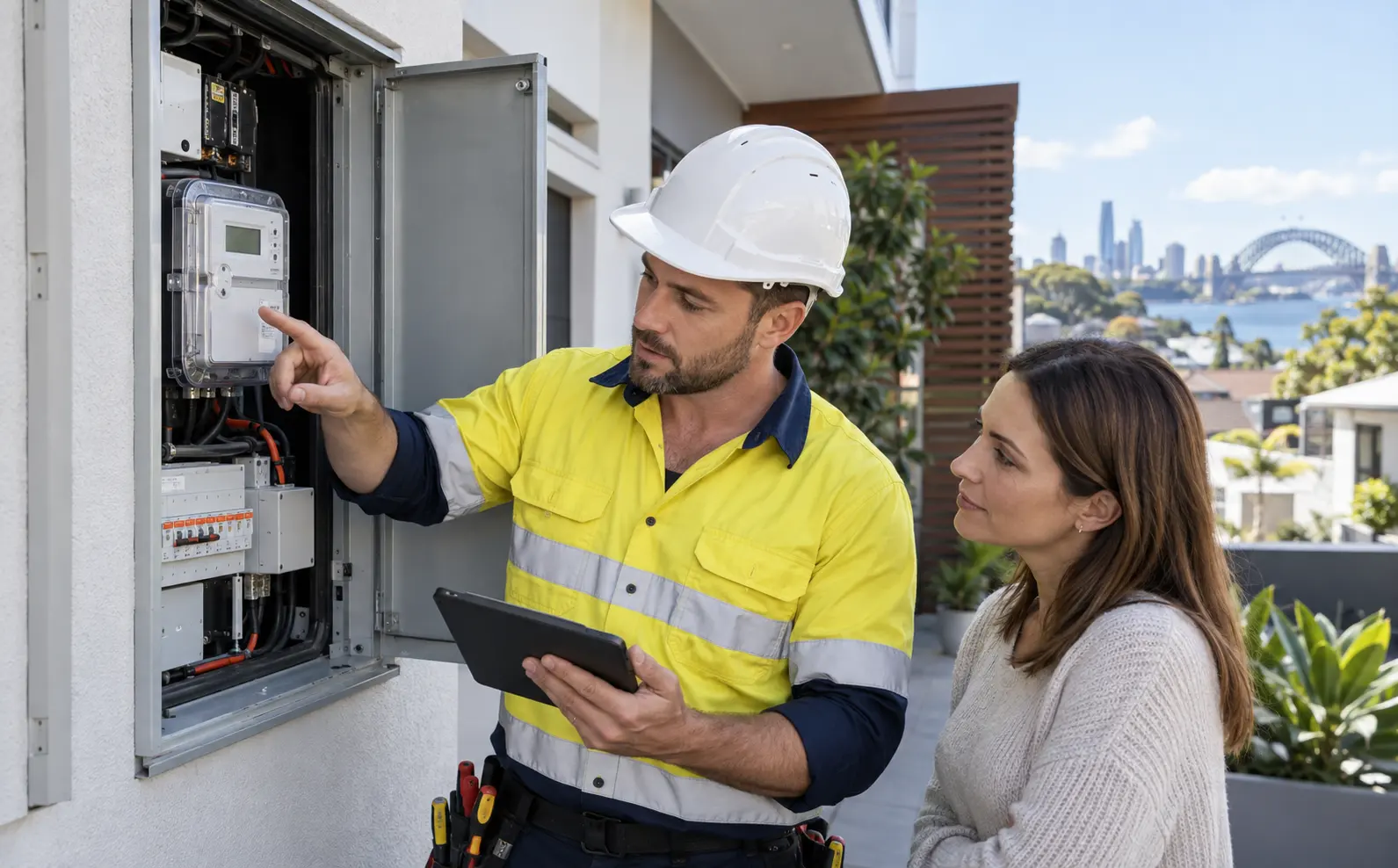
If your electricity meter still has a spinning dial or a set of number wheels, its days are numbered. NSW is part of a national push to have a smart meter in every home and small business by 2030, and the rollout is moving quickly through 2026. Plenty of Sydney homeowners aren’t waiting for their turn, though, especially anyone adding solar, a battery or an EV charger who wants the data and billing options a smart meter unlocks.
So how do you actually get one, and what does it cost? There are two paths, and the right one depends on whether you’re happy to wait or you want it sorted now.
What a smart meter actually does
A smart meter is a digital device that records your electricity use in short intervals, usually 30-minute or 5-minute blocks, and sends that data straight to your energy retailer without anyone reading it manually. Older accumulation meters just tick over a total and need a meter reader to visit.
That difference matters more than it sounds. With interval data you can move onto time-of-use tariffs, see exactly when you’re using power, track what your solar is exporting, and run a battery or virtual power plant properly. If you’ve got solar or a battery on the way, a smart meter isn’t optional, it’s the thing that makes the setup work.
Path 1: Wait for the free rollout
The simplest way to get a smart meter costs you nothing upfront. Under the national rollout, your electricity retailer contacts you when it’s your turn, arranges a metering provider to attend, and swaps the meter over. For a straightforward site there’s no upfront charge, and you’re notified in advance before anyone turns up.
The swap itself is quick. The physical replacement usually takes about an hour, and your power is off for part of that.
The catch with the free path is timing and control. You get the meter when the rollout reaches you, not when you want it, and it comes through whichever provider your retailer sends. If you’re mid-way through a solar or battery install, or you simply want it done on a schedule that suits you, waiting isn’t ideal.
There’s also an ongoing cost worth knowing about. The meter itself is generally folded into your daily supply charge rather than billed as a lump sum, so while there’s no upfront fee on the standard path, you do pay for it over time through your energy bill.
Path 2: Arrange it yourself through a Level 2 electrician
If you want a smart meter now, on your timeline, or your switchboard needs work before a meter can safely go in, you arrange the installation directly. This is the path most Sydney homeowners take when they’re upgrading for solar, adding an EV charger, or dealing with an old meter board that isn’t up to standard.
Here, cost depends on the job. A simple meter upgrade in NSW commonly runs somewhere in the range of a few hundred dollars, with more complex installations costing more where extra electrical work is involved. The variable isn’t the meter, it’s the condition of everything around it. Around 90% of swaps go in cleanly. The other 10% need additional work first to make the existing setup safe to upgrade.
Common reasons a job costs more:
- An old or unsafe meter board that needs replacing or rewiring first
- Switchboard upgrades to meet current standards
- Moving from single phase to three phase power
- Poor access or a site with unresolved electrical defects that must be fixed before the meter goes in
The upside of paying for it yourself is speed and certainty. You book it, it happens, and any board or supply issues get handled in the same visit rather than derailing a rollout appointment later.
Who can legally install a smart meter in NSW?
This is the part people get wrong. You can’t install a smart meter yourself, and neither can a standard electrician. In NSW, meter installations and upgrades that connect to the electricity network legally require an Accredited Service Provider (ASP) Level 2 electrician.
A Level 2 ASP is licensed to work on the network side of your supply, which covers the service line between your property and the grid, the connection point, and metering work tied to network assets. General electricians hold a standard licence that doesn’t extend to this. If a job touches your incoming mains or the point of supply, it’s Level 2 work.
Brian Brothers Electrical is a licensed Level 2 ASP team working across the Ausgrid and Endeavour Energy networks in Sydney, which is exactly what smart meter installation calls for.
The installation process, step by step
Whichever path you take, a proper installation runs roughly like this:
- Assessment. The electrician inspects your current meter, switchboard and site conditions to confirm the setup is safe to upgrade.
- Any prep work. If the board is old or there’s a defect, that gets fixed first. This is where switchboard or consumer mains work may come in.
- Disconnection. Your power is safely turned off for the swap.
- Installation. The old meter comes out and the smart meter goes in and is connected to the network.
- Reconnection and activation. Power is restored, and the meter is registered so your retailer can start receiving data.
- Compliance certificate. The electrician lodges the paperwork that proves the work meets NSW standards.
The compliance rule you should know about in 2026
There’s a recent change worth flagging. From 1 July 2026, every Certificate of Compliance for Electrical Work (CCEW) in NSW must be lodged through the Building Commission NSW eCert portal. Handwritten and PDF forms are no longer accepted, and the certificate has to be submitted within seven days of the work being tested.
For you as the homeowner, this matters for one practical reason: activation. A smart meter isn’t truly finished when it’s screwed to the wall, it’s finished when the compliance paperwork is lodged correctly and the meter is activated. Get that wrong and you can end up with data transmission problems that stall things like solar exports or battery setups. Using a licensed electrician who lodges certificates properly through eCert is what keeps the whole thing clean.
Should you wait or arrange it now?
Wait for the free rollout if your current meter works fine, you’re not adding solar, a battery or an EV charger, and you’re happy to get the meter whenever your retailer reaches you.
Arrange it yourself through a Level 2 electrician if you want it on your schedule, you’re installing solar or a battery, you need an EV charger, or your meter board is old and likely needs work first. The certainty of getting the supply side sorted in one visit is usually worth it.
Get your smart meter sorted in Sydney
Whether you’re future-proofing an older home, prepping for solar and battery, or your meter board simply needs bringing up to standard, a smart meter upgrade needs a licensed Level 2 ASP electrician to do it legally and safely.
Brian Brothers Electrical handles metering services and the switchboard, consumer mains and defect work that often goes with them, across Sydney’s Ausgrid and Endeavour Energy networks. Get in touch for a quote and we’ll assess your site and tell you exactly what your upgrade involves.
FAQs
How much does a smart meter cost to install in Sydney?
On the free national rollout there’s no upfront cost, though you pay for the meter over time through your daily supply charge. If you arrange it yourself, a simple upgrade in NSW commonly runs a few hundred dollars, and more where switchboard work or a supply upgrade is needed first.
Can I get a smart meter installed before my rollout turn?
Yes. You don’t have to wait for your retailer’s rollout schedule. You can arrange a smart meter directly through a licensed Level 2 ASP electrician, which is the usual route for anyone adding solar, a battery or an EV charger.
Who is allowed to install a smart meter in NSW?
Only an Accredited Service Provider (ASP) Level 2 electrician can legally install or replace a smart meter in NSW, because the work connects to the electricity network. A standard electrician’s licence doesn’t cover it.
How long does a smart meter installation take?
The physical swap usually takes about an hour, with your power off for part of that. Jobs that need switchboard or meter board work first will take longer.
Do I need a smart meter for solar or a battery?
Effectively, yes. A smart meter records the interval data needed to track solar exports, run a battery correctly and join a virtual power plant. Solar and battery setups rely on it to work properly.
Why would a smart meter installation cost more than expected?
Extra cost almost always comes from the setup around the meter, not the meter itself. An old or unsafe meter board, a switchboard that needs upgrading, moving to three phase power, or unresolved electrical defects all add work that has to be done before the meter can go in safely.
What is the eCert compliance rule for 2026?
From 1 July 2026, all electrical compliance certificates (CCEWs) in NSW must be lodged digitally through the Building Commission NSW eCert portal within seven days of the work. It’s the electrician’s job to submit it, and correct lodging is part of getting your meter activated properly.