

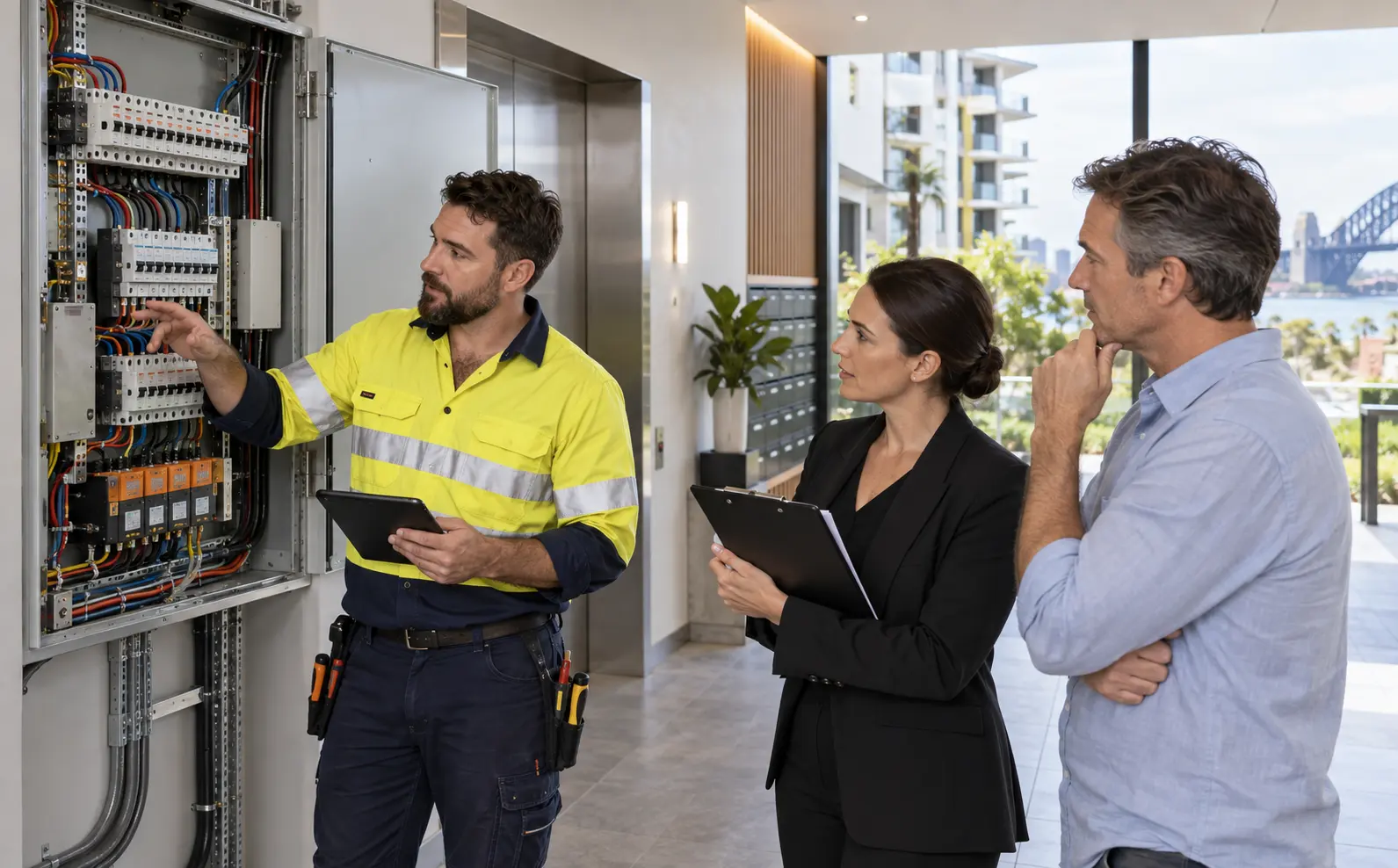
If you live in an apartment, townhouse or unit block anywhere in Sydney, at some point you’ll flip a switch and nothing happens. Then comes the more expensive question: is this your problem to fix, or the building’s? Under NSW strata law the line between the two is not always obvious, and getting it wrong can leave you paying for work that was never yours to pay for.
Here’s how the responsibility actually splits, where the grey areas sit, and when you need a licensed electrician to sort it out.
The basic rule: common property vs lot property
Every strata scheme in New South Wales is divided into two zones. There’s common property, which the owners corporation (the collective body of all owners, sometimes still called the “body corporate”) looks after and pays for. And there’s your lot, which is your responsibility as the individual owner.
The dividing line is usually the internal surface of the walls, floors and ceilings of your unit. Anything on your side of that line tends to be yours. Anything on the building’s side, or servicing more than one lot, tends to belong to the owners corporation.
Electrical wiring is where this gets messy, because cables run through walls that straddle both zones. So the practical test is less about where a wire physically sits and more about what it serves and where the fault is.
Electrical work the owners corporation usually pays for
The owners corporation is generally on the hook for electrical infrastructure that is shared or that forms part of the building’s common systems. In most Sydney schemes that covers:
- The main switchboard and any common-area distribution boards feeding shared services
- Wiring and lighting in hallways, stairwells, foyers, car parks and garages
- Security and access systems, intercoms, electric gates and shared CCTV
- Lifts and their electrical supply
- Common-area power points used for cleaning or maintenance
- Exterior and pathway lighting
- The consumer mains feeding the building from the network before they split off to individual meters
If a fuse blows in the basement and half the car park goes dark, that’s a common property issue and the strata scheme wears the cost. The same goes for a failed foyer light or a faulty intercom panel. For work on the building’s incoming supply or shared boards, the owners corporation will need a licensed electrician, and where the fault sits on the network side of the meter, an ASP Level 2 electrician with authority to work on those connections.
Electrical work the lot owner usually pays for
Inside your own unit, the wiring, fittings and appliances are almost always yours. That typically means:
- Power points and light switches within your lot
- Light fittings and their globes inside your apartment
- Your unit’s own appliances, oven, cooktop, rangehood and hot water unit where it serves only your lot
- Any wiring you or a previous owner added, such as extra outlets, downlights or a renovation circuit
- Faults on the load side of your meter that only affect your unit
So if a single power point in your bedroom stops working, or your own rangehood needs replacing, that’s a lot of cost. The building isn’t involved.
A quick reality check: if the problem is contained entirely inside your four walls and nobody else in the block is affected, assume it’s yours until proven otherwise.
The grey areas that cause the most arguments
Most strata electrical disputes don’t happen at the obvious extremes. They happen in the middle, and these are the ones worth understanding before a bill lands.
Safety switches and circuit breakers
Whether an RCD or breaker is common property or lot property depends on which board it lives in and what it protects. A safety switch in the common main board protecting shared circuits is the owners corporation’s. One inside your unit’s own board protecting your circuits is usually yours. If your safety switch keeps tripping, an electrician can trace the fault and tell you which side of the line it falls on before anyone commits to paying.
The electricity meter and consumer mains
Individual meters and the wiring feeding them sit in a genuinely awkward spot. The meter itself is often network or retailer property, but the consumer mains running to it, and any shared metering arrangement, frequently land with the owners corporation. When a block has a single main and sub-meters for each lot, responsibility for the shared portion almost always sits with strata.
Original wiring inside walls
Wiring that came with the building, even where it runs inside your unit’s walls, can still be common property in some schemes, because it was installed as part of the original common infrastructure. Wiring added later during a renovation is yours. When a wall needs opening up, this distinction decides who pays, and it’s worth checking your strata plan rather than assuming.
Hot water systems
A hot water unit serving only your apartment is generally your responsibility. A central or shared hot water plant serving multiple units is the owners corporation’s. If you’re not sure which you have, the hot water system setup in your block will tell you: an individual tank inside or beside your unit points to a lot of cost.
Electrical defect notices in strata buildings
Sometimes the trigger isn’t a breakdown, it’s a notice. If Ausgrid or another network provider issues an electrical defect notice against a Sydney strata building, someone has to act fast, and the repair often involves common infrastructure like the main board or consumer mains.
These notices carry deadlines, and ignoring one can lead to disconnection. Because defect work usually touches the network side of the supply, it needs a Level 2 defect repair specialist rather than a general electrician. The owners corporation typically coordinates and funds this where the defect sits in common property.
What to do when you’re not sure who pays
Before you spend a dollar, work through this order:
- Identify what’s affected. Only your unit, or shared areas and other lots too?
- Check your strata plan and by-laws. These define the boundary of your lot and often spell out common property.
- Ask your strata manager or committee if it looks like common property, so the owners corporation can arrange and fund the work.
- Get a licensed electrician to diagnose the fault if the source isn’t obvious. A proper diagnosis often settles the who-pays question on its own.
That last step matters more than people expect. A qualified electrician can pinpoint exactly where a fault originates, which is frequently the single fact a strata committee needs to approve or decline a claim.
When strata electrical work needs a Level 2 electrician
A lot of strata electrical work, especially anything touching the building’s incoming supply, main switchboard, consumer mains or the network connection, legally requires an Accredited Service Provider (ASP) Level 2 electrician. General electricians can’t perform this work.
Brian Brothers Electrical is a licensed Level 2 ASP team working across Sydney, handling exactly this kind of job for strata buildings, owners corporations and individual lot owners. That includes switchboard and defect repairs, consumer mains work, metering services, safety switch installation and disconnection and reconnection of supply.
Whether you’re a lot owner facing a repair you think might be the building’s, or a strata committee dealing with a defect notice, getting the right licensed electrician in early saves both money and arguments.
Sort out your strata electrical issue the right way
The who-pays question in strata electrical maintenance comes down to one thing: is the fault in common property or in your lot? Shared infrastructure is the owners corporation’s; anything serving only your unit is yours. The grey areas around meters, safety switches and original wiring are where a professional diagnosis earns its keep.
If you’re dealing with an electrical fault in a Sydney strata building and you’re not sure who’s responsible, get in touch with Brian Brothers Electrical. As a licensed Level 2 ASP team, we’ll diagnose the fault, tell you which side of the line it sits on, and carry out the repair properly.
FAQ:
1. Does strata pay for electrical repairs in NSW?
Strata (the owners corporation) pays for electrical repairs to common property, meaning shared infrastructure like the main switchboard, common-area wiring, hallway and car park lighting, intercoms, and the consumer mains feeding the building. Under section 106 of the Strata Schemes Management Act 2015, the Owners Corporation has a statutory duty to properly maintain and keep common property in a state of good and serviceable repair. Repairs to wiring, power points and fittings inside your own unit are the lot owner’s cost. Jamesons
2. Who is responsible for a faulty power point in a strata unit?
A faulty power point inside your apartment is almost always the lot owner’s responsibility, because it sits within your lot and serves only your unit. The rule of thumb is that the lot owner covers everything inside the airspace of the unit, including internal fixtures, while the owners corporation covers shared property outside it. Metro-strata
3. Who pays for switchboard repairs in a strata building?
It depends on which board it is. The building’s main switchboard and any common distribution boards feeding shared services are the owners corporation’s responsibility. A private board inside your unit that only protects your circuits is usually yours. Because main switchboard and supply work often touches the network side, it typically requires a licensed Level 2 ASP electrician.
4. Is original wiring inside my unit’s walls common property?
Often, yes. Wiring installed as part of the building’s original infrastructure can remain common property even where it runs through your unit’s walls, because common property generally includes pipes, wires and cables that service more than one lot. Wiring you or a previous owner added during a renovation is your responsibility. Your strata plan is the deciding document. Progressive Strata
5. Who fixes electrical faults in common areas like hallways and car parks?
The owners corporation arranges and pays for these. Electrical faults, including outages or damaged wiring in common areas, count as urgent repairs that the owners corporation must act on promptly. A blown foyer light, a dark car park or a failed intercom all fall on strata, not the individual owner. Strataunited
6. Can I do the electrical repair myself and claim it back from strata?
Not safely, and not without approval. Electrical work must be done by a licensed electrician, and for common property you should get the owners corporation’s consent first. You can apply to the NSW Civil and Administrative Tribunal (NCAT) for orders that compel the owners corporation to perform the work or pay you to carry it out, but it is best to seek consent or an NCAT order before doing work yourself. PBL Law Group
7. What happens if strata gets an electrical defect notice?
If a network provider issues an electrical defect notice against the building, the owners corporation usually coordinates and funds the repair where it involves common infrastructure like the main board or consumer mains. These notices carry deadlines and can lead to disconnection if ignored, and the work needs a Level 2 defect repair specialist rather than a general electrician.